
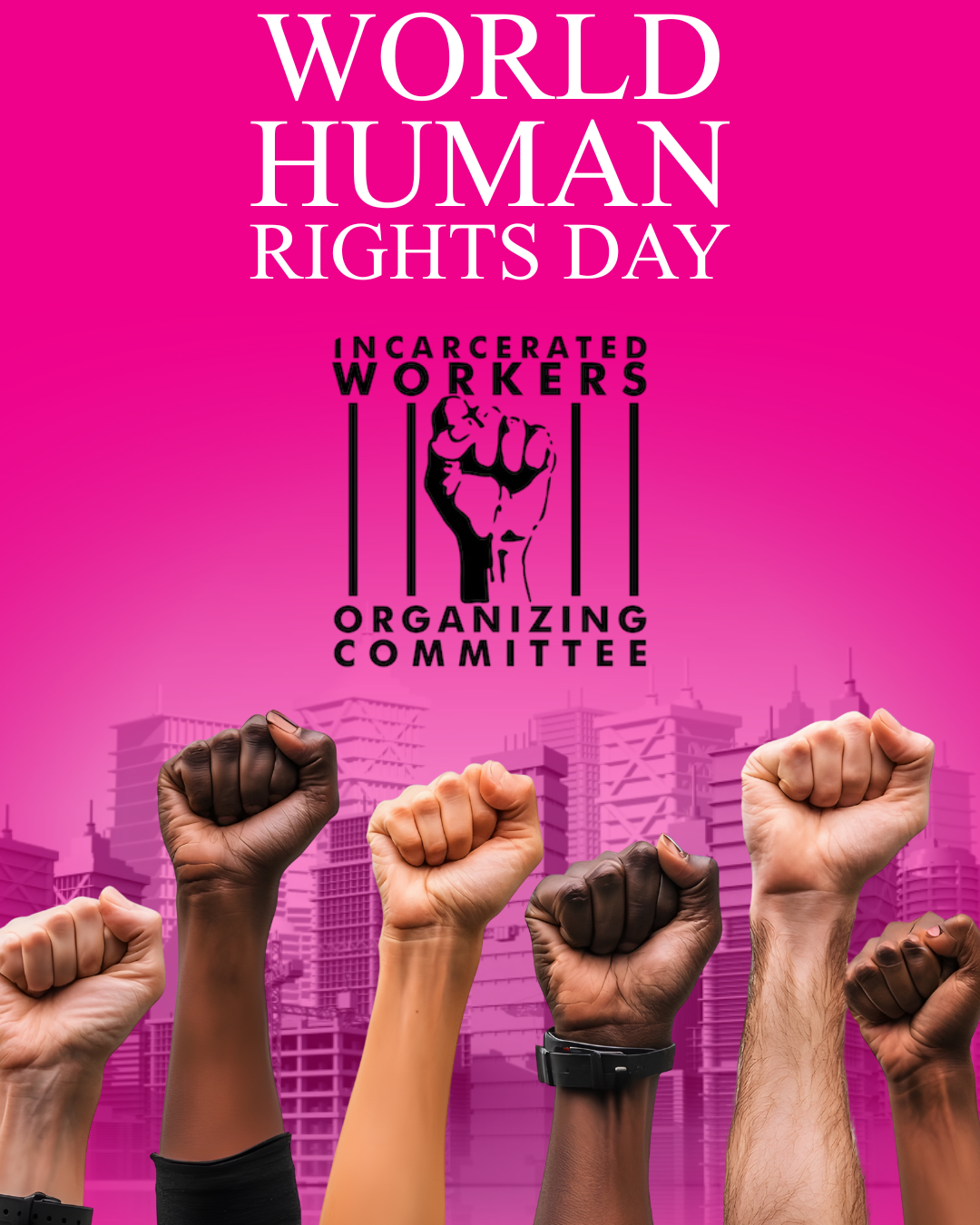
Today, Beyond is proud to recognize World Human Rights Day alongside our community partner Incarcerated Workers Organizing Committee — Chicago (CIWOC). Commemorated annually on December 10, World Human Rights Day marks the anniversary of the Universal Declaration of Human Rights’ (UDHR) adoption by the United Nations in 1948. Following the horrors of World War II, the international community came together to establish a shared commitment for and universal recognition of justice, dignity, and freedom for all peoples. At its core, the UDHR affirmed that human rights were inalienable, not conferred, and inherent to each and every person.
Seventy-six years later, however, that promise remains fractured across the United States, especially for people incarcerated in prisons, jails, and detention centers.
In many spaces and organizations, World Human Rights Day is often framed as an occurrence that marks human rights progress as something that happens elsewhere. However, that requires further scrutiny given stark realities facing our country. The US incarcerates more people than any other nation in the world, and those in detention often face significant challenges to accessing and preserving their human rights. People are routinely held away from their families who can ensure they are being treated with dignity and respect. Limited communication means that harm can happen swiftly, behind walls that keep the potential for accountability distant.
CIWOC recognizes the need for greater transparency and works to make that a reality for incarcerated people, today. CIWOC is a majority-inside organization based in Illinois that works directly with incarcerated community members. Their members inside prisons organize alongside people outside of detention to challenge abuse, neglect, and isolation created beneath the carceral system. Beyond had the opportunity to connect with Joe, one of CIWOC’s central organizers, and discuss the revolutionary work they continue to lead. As Joe puts it:
“The human rights of people locked in US controlled prisons, jails, and detention centers are often overlooked because they are held with limited communication, in remote areas, away from their loved ones. They are refused basic dignity and have become dehumanized to the point to which prisons have become a human rights crisis.”
This reality stems from the fact that dehumanization is not a matter of if it happens but when. The sheer scale of the system plays a central role in such. In Illinois alone, the Department of Corrections is a sprawling entity that requires nearly $2 billion in a single year to incarcerate nearly 30,000 people. Beyond this, many prisons function to extract additional labor from incarcerated community members who are often paid pennies or, in many cases, nothing at all, labor that is often essential to the running of the detention centers themselves. Depriving people of human interaction, appropriate medical and psychosocial care, and dignity are not aberrations; they are central tools for this system’s operation and control over community members.
“Recognizing Human Rights Day means recognizing that prisons cannot exist within violating human rights,” Joe shares. With this recognition, CIWOC continues to work tirelessly to address these realities for those within the system. CIWOC’s focus remains on breaking through the system’s practice of isolation in order to create greater accountability and visibility. When community members are faced with medical emergencies, unsafe conditions, or retaliation, many often start with advocating for themselves and their inherent rights. Should retaliation or punishment occur because of that advocacy, CIWOC steps in. Whether contacting prison staff, administrators, or state officials and highlighting violations alongside Beyond’s staff, our partnership diligently pursues every avenue possible. By joining forces, CIWOC and Beyond are able to hold officials accountable through legal action, mutual outreach, or working with incarcerated community members to document violations while understanding their rights. This joint approach from the inside and outside works. As Joe highlights, “It shows that people on the outside are fully aware of what is happening to people on the inside, increasing the chance of their human rights being restored.”
As we recognize the importance of World Human Rights Day, let us be reminded that this commemoration is not an abstract one; it is about the fair and equal application of human rights to all people. Harm does not disappear when it is hidden from public view, just as dignity and justice cannot vanish at the prison gate.